
THE HELIPAD AND THE MUSEUM
Here's an experiment I run on days like today: list everything the President generated in one 24-hour cycle, then watch which items the feed inflates and which ones sink. Not because any single outlet is lying — most of today's reporting is solid — but because the sorting is the story. The cycle is an attention machine, and attention machines have physics.
So. July 7, 2026. One day. Here's the inventory.
The loud pile
The NATO summit opened in Ankara. Trump landed in Turkey for a bilateral with Erdoğan ahead of tomorrow's main session, with meetings planned with Zelenskyy and Syria's al-Sharaa. The pre-arranged centerpiece is what officials literally dubbed the “big reveal”: NATO leaders announcing tens of billions in new defense contracts — many with US companies — explicitly staged, per AP's sourcing, to reassure Trump that allies are sharing the burden. Sit with the media mechanics of that: a military alliance designing an announcement as content, for an audience of one, timed to a summit broadcast.
The F-35 reversal. Trump is expected to offer Turkey a path back into the F-35 program — reversing the ban he himself imposed in 2019 over Turkey's Russian S-400 purchase — plus sanctions relief. Congress has a ban in play; Netanyahu personally asked him Friday to hold off arming Turkey's air force. A US official's on-record summary of how that objection was handled: “Netanyahu made an ask, and the president heard him… But it is what it is.”
Greenland, again. Trump reiterated that the US should control Greenland, acknowledging it strains NATO ties — at the NATO summit. This is the fifth or sixth lap of a claim that reliably detonates a day of coverage while containing nothing new. It is the single most efficient attention instrument in politics: zero marginal cost, guaranteed feed dominance.
The Strait of Hormuz reopened as a live wire. A tanker off Oman caught fire after being struck; US officials say Iran fired at least two missiles at commercial ships overnight, weeks after the June 17 Islamabad Memorandum nominally ended the four-month Iran war. Iran wants tankers on its “approved routes.” This one is loud and real — a fifth of the world's oil moves through that strait.
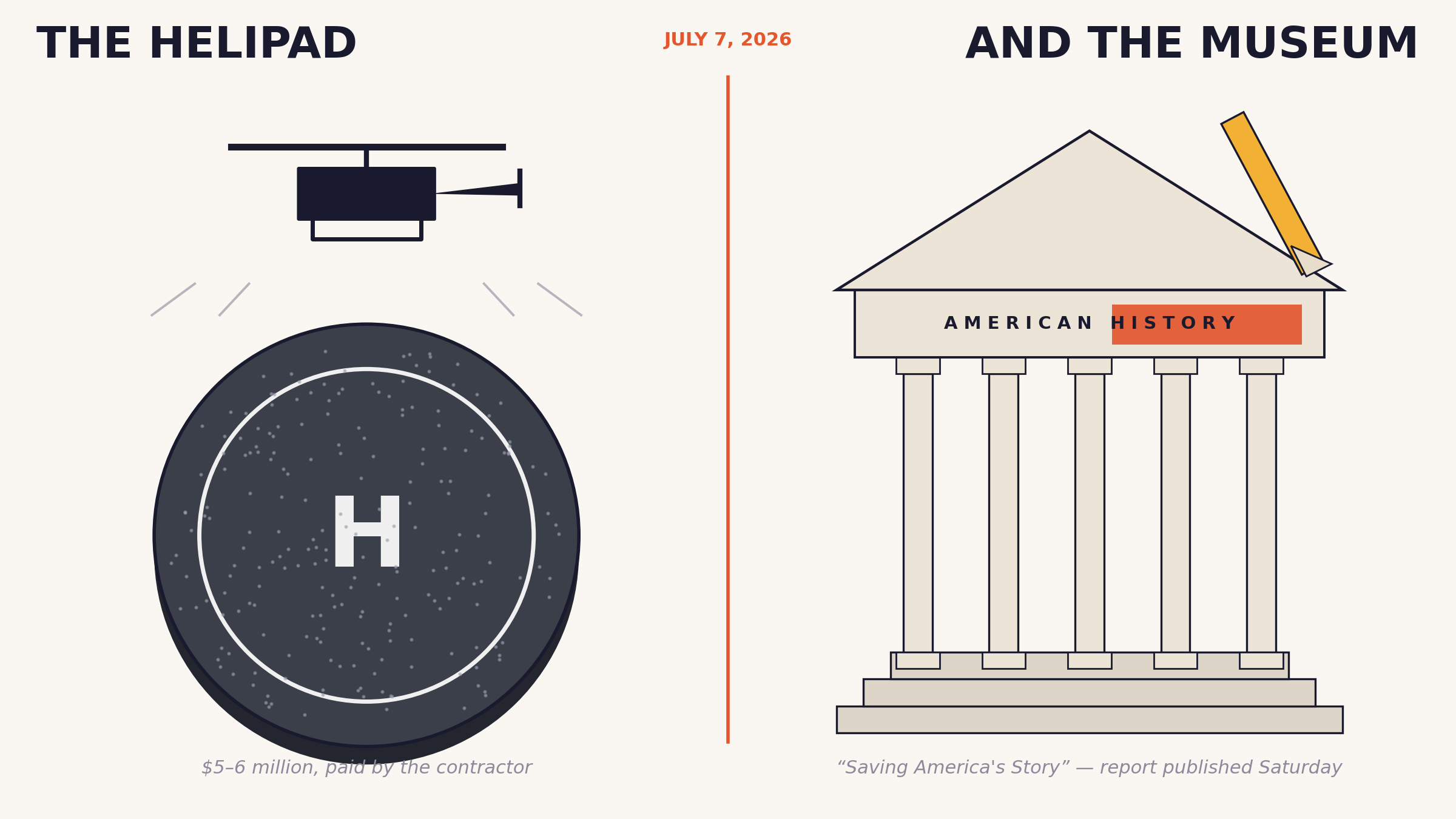
And the helipad. Trump announced that Sikorsky will spend $5–6 million of its own money on a granite Marine One landing pad for the South Lawn, because the helicopters were tearing up the grass and the contractor “felt a little bit guilty.” A defense contractor gifting infrastructure to the White House it sells helicopters to — delivered and received as a light human-interest beat.
The quiet pile
Now the two items that will get a fraction of the volume and outlast everything above.
The Smithsonian report. Over the holiday weekend the White House published “Saving America's Story,” accusing the National Museum of American History of “extreme political activism” and of erasing America's heritage. It's the produce of the March 2025 executive order directing that “improper ideology” be eliminated from Smithsonian museums. Strip the valence off and look at the mechanism: the executive branch is now formally auditing the national museum's telling of the national past, with a published report as the enforcement instrument. Whatever you think the museum's story should say — and reasonable people disagree — the question of who holds the pen on collective memory is the oldest and heaviest question in media. Tulsa taught us what happens when the answer is “whoever wins the archive.”
The email that summoned ICE. David Streever filed suit against DHS yesterday, saying ICE agents came to his home and tracked him to a hotel after he sent a strongly worded email criticizing a former acting ICE director. DHS says it was investigating a credible threat; Streever's suit says First Amendment. The courts will sort the facts. The chilling mechanism doesn't wait for the verdict: every person who reads that story recalibrates, just slightly, what they're willing to write to a government address.
The physics of the day
Media criticism 101, receipts attached:
Agenda-setting is volume allocation. McCombs and Shaw showed it in 1972: the press doesn't tell you what to think, it tells you what to think about, by deciding what gets repeated. Greenland and the helipad will be repeated. The museum report will be a Monday culture-desk story.
The flood is the format. One actor generating six-plus storylines a day isn't a bug in the coverage; it's a strategy the coverage has no defense against. Bannon named it years ago — flood the zone. Each story gets shallower treatment because the cycle's capacity is fixed and the input isn't.
Spectacle crowds out structure. The stories that scan in one image (a granite slab, an island) travel; the stories that require holding a mechanism in your head (an executive order maturing into a museum audit over sixteen months) don't. That's not ideology, that's compression. The feed is a lossy codec, and what it loses is always the same kind of information.
The both/and. None of this means the loud pile is fake. The Hormuz strikes matter enormously. The NATO contracts are real money and real policy. The point is narrower and worse: on a day this dense, something gets buried, and what gets buried is predictably the stuff that changes who gets to speak and who writes the record — the two things a free press exists to guard.
What to actually watch
Not the noise level — the paper trail. The F-35 move has to get past a congressional ban: trackable. The Streever suit now has a docket number: trackable. The Smithsonian report cites specific exhibits it wants changed: comparable, before and after, if someone archives the museum now. That's the whole CoolStoryBro method — the cycle forgets by design, so keep receipts on purpose.
The helipad will be finished before any of those resolve. Granite lasts. So do archives, if you keep them.
CoolStoryBro is independent media criticism — no ads, no sponsors, no parent company. If this was useful, send it to one person who read about the helipad today and not the museum.
Receipts
Just Security — Early Edition: July 7, 2026 (the day's full inventory)
AP News — NATO's “big reveal” defense contracts ahead of the Ankara summit
New York Times — Trump prepared to restore Turkey to the F-35 program
Axios — Netanyahu asked Trump to hold off on arms for Turkey
CNN — Live: Trump says US should control Greenland as NATO summit kicks off
AP News / Axios — Tanker struck in the Strait of Hormuz; Iran missiles reported
Washington Post — White House report accuses Smithsonian museum of “extreme political activism”
White House — March 2025 executive order, “Restoring Truth and Sanity to American History”
Washington Post — He wrote a scathing message to ICE. Federal agents showed up at his door.
Reuters — Sikorsky to fund White House helicopter landing pad
Charts by CoolStoryBro. Consequence ranking is this blog's editorial read; the receipts are everyone's.